
Short & Sweet:
North Chicago's
Robert A. Black
By Joe W.
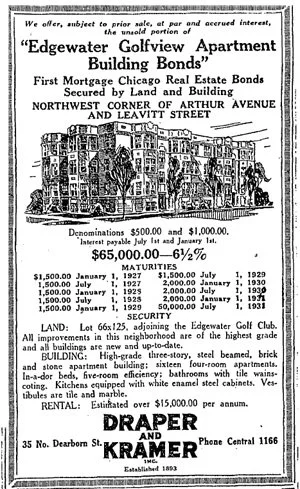
Founded in 1896, of North Shore elite’s need for recreation, Edgewater Golf Club was once a place of elegant dinners and debutante balls, this club was built on some of the most contested land in a well established neighborhood. However, after decades of financial difficulties and a prolonged legal/zoning dispute, the no-nonsense 18 holes, lacking any doglegs, camber, or water features was sold to the State of Illinois for a record $8 million. This land was shortened to 9 holes (the remaining land becoming Warren Park) and redeveloped by architects Kenn Killian and Dick Nugent in 1980 to include more engaging greens complexes, provocative bunker placement and the occasional dogleg, becoming the perfect everyday course for any class of Chicagoan.
Named after Robert Alfred Black, a prominent south-side doctor and Chief Engineer to the Chicago Park District, R.A.B., as it has come to be known, has become a pillar of affordable, approachable and endlessly entertaining golf within Windy City limits. Perched on one of the City’s furthest north neighborhoods, the facility is seldom overbooked, as most Northside suburbanites would rather venture further north to open (and possibly more equipped) pastures, seldom leaving the tee sheet full. As you arrive, you are greeted with a quaint, nostalgic clubhouse, with golfers and parkgoers loitering the outdoor table areas, settling scores or playing cards. As you walk to the first hole you will notice an almost shockingly pristine putting area, much larger than you would imagine. Beyond that, lays a pitching and chipping area equipped with a practice bunker. The first hole is a cold opening. The course’s sole Par 5 is a light dogleg right with a bunker guarding the left side at 260. The shot is clear, but coming fresh out of the parking lot, are you willing to gas a driver up the right side after it on a reachable 5? Or do you, with houses lining the left side and an adjacent fairway down the right, play more sensibly.
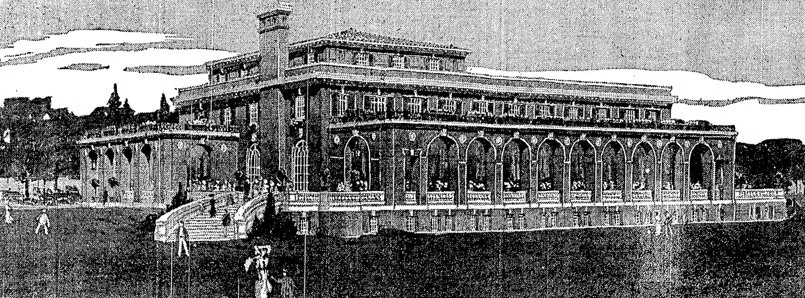
Proposed clubhouse designed by Holabird & Roche that was never built.
The course is not long (2361 yards from the back tees), but length, thick rough or hazards are not what challenges players here. The challenge lies in the necessity of positioning and the temptations of glory. The third hole is a 90 degree dogleg left. The fairway ends 250 from the back tees, and the course's largest bunker guards the corner of the turn with Warren Park peeking at you through a chainlink fence. Again, the question is simple, do you take a headcover off to a green that is achievable with the right shot? Or do you place one 200 from your tee, and trust your approach? Neither one of these options are right or wrong (however I can tell which has historically worked more for me). This decision making quality is the essence of the course and the sport. Not swinging a club, but making a choice with finality. Whichever play that is, play it with assertion.
You can feel yourself improving all aspects of your game when you play here. You feel childish when you choose to go for it, and grown up when you make what you feel is a sensible choice. This does not mean always laying up.
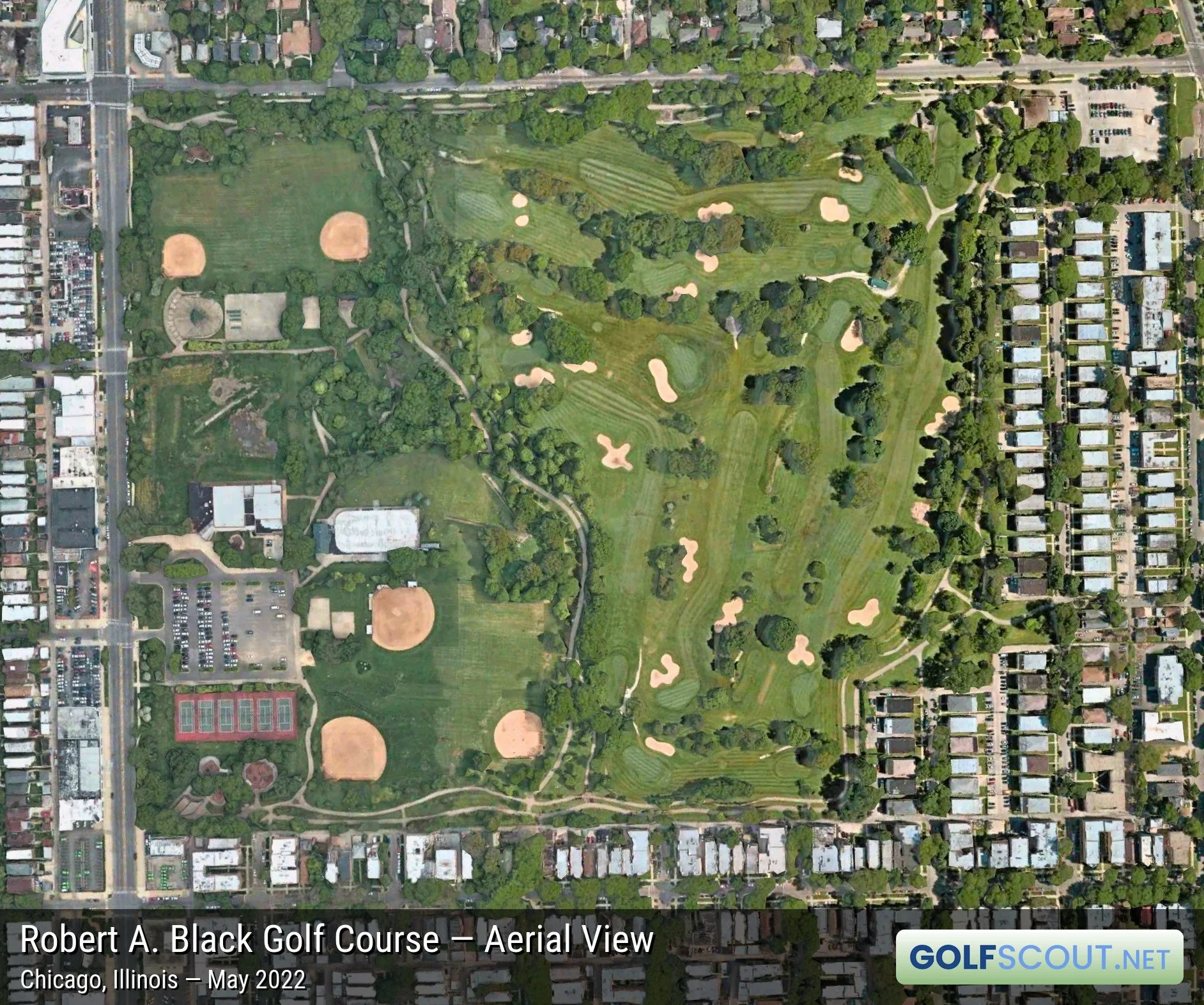
Hole 5 is a short par 4. Lined down the right is the same grouping of trees that you saw coming from the other way on hole 1. Creeping over the fairway from the left is a tree that looks older than the course does. It takes up much of the airspace for any shot going over this fairway. A layup short at the 150 stake can be made more difficult with the tree blocking your sightline into the green. Ever ambiguous, the correct answer cannot be found explicitly, only from within the player. An iron shot short of the tree, or maybe a driver over the top of it? An ounce of doubt in this decision does not bode well for the player.
The tee shots are not the only sources of adjudication. With the Killian and Nugent redesign came greens complexes that are infinitely more inspired. Bunkers often guard strategic positions that lead players to ideate. The greens themselves are tiered in ways that allow for creativity and to punishment, given any individual approach. Hole 8, a sub-100 yard par 3, has three distinct tiers that stairstep up a hill. These slopes are steep enough to both allow for a backstop if the situation calls for it, and rejection if you do not play with accuracy.
The layout of the course allows for this to be the perfect place to develop relationships with your own golf game and any others playing with you. How seriously do they take their game (and themselves)? Can they pull off the shots with confidence, whichever shot that may be? Do they keep score? Are they wanting to get better or just have a good time? I can say that I’ve enjoyed every time I’ve had the chance to walk nine at R.A.B, and I can say with confidence that I have learned something every time I have.
Forgotten Chicago. “Edgewater Golf Club.” December 13th, 2010
GolfScout. “Robert A. Black Golf Course (Chicago, Illinois).” Accessed April 19, 2026.
Chicago Park District. “Warren (Laurence) Park.” Accessed April 19, 2026.